
Architecture Without Bureaucracy: How to Set Technology Standards That Teams Will Actually Follow
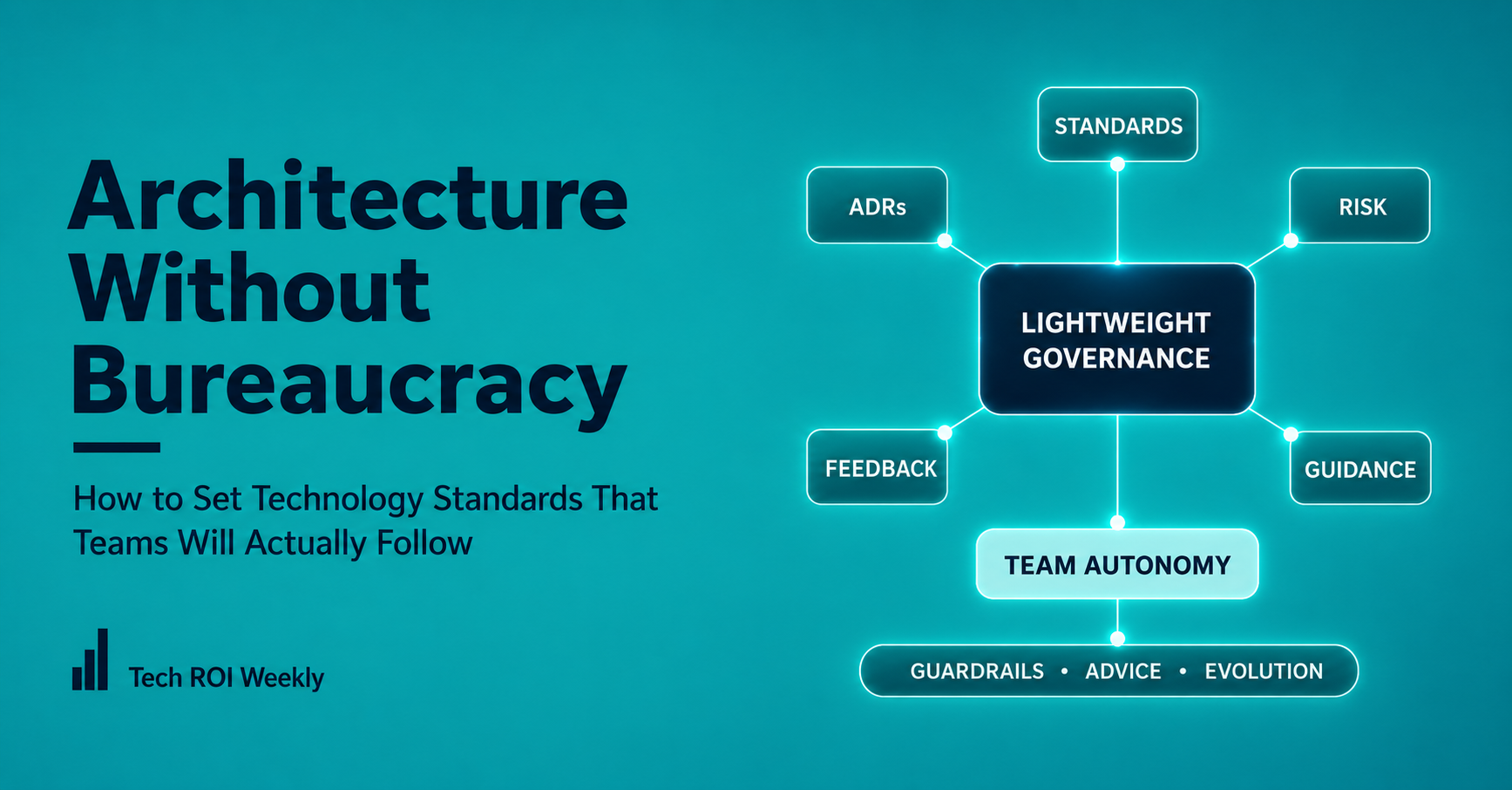
Architecture governance fails in two opposite ways. There can be too much of it, or too little.
Too much governance creates friction. Teams prepare presentations for review boards, wait for approval, and learn that the safest route is often to avoid triggering the process. Standards become documents to satisfy rather than tools that improve engineering decisions.
Too little governance creates fragmentation. Teams make local technology choices without enough shared context. Over time, the organisation can accumulate incompatible patterns, duplicated capability, inconsistent controls, and unnecessary operational complexity.
The purpose of architecture governance is not to maximise control. It is to create enough shared structure to protect the organisation from high consequence mistakes while preserving team autonomy for decisions that are local and reversible.
Thoughtworks describes lightweight technology governance as an approach that reduces friction by moving from mandates toward principles and guardrails, automating and delegating compliance, turning gatekeepers into collaborators, providing paved roads, radiating information, and allowing governance to evolve. That is a useful foundation for a modern architecture operating model.
1. Why architecture governance fails
Failure mode 1: The review board becomes the architecture process
Architecture boards can be useful. The Open Group’s TOGAF material describes an Architecture Board as a governance mechanism for overseeing architecture strategy and reducing unconstrained, one-off development. The problem begins when the board becomes the place where almost every meaningful engineering decision must wait for central approval.
A review board should concentrate on decisions with enterprise-wide consequences, material risk, or high reversal cost. If the same governance path is applied to routine framework, library, or configuration choices, the process becomes a queue rather than a control.
The practical test is simple: does the review materially reduce risk or improve a difficult decision? If not, the governance path is too heavy.
Failure mode 2: Standards exist, but the engineering path ignores them
A standards document does not create a standardised estate by itself. Teams adopt patterns when they understand the rationale and when the preferred path is easier to use than inventing a local alternative.
Thoughtworks uses the term paved road for centrally supported tools, services, templates, and delivery patterns that make the preferred route easy to follow. The point is not to force every team onto one implementation. It is to reduce the cost of making a sound choice.
If a standard says what teams must do but provides no reference implementation, starter template, automated control, or migration guidance, it is governance on paper rather than governance in the delivery system.
Failure mode 3: Architecture is positioned as approval rather than expertise
When architects are engaged only at the end of a design process, they see decisions after teams have already invested in them. At that point, architecture review tends to become either a rubber stamp or a late blocker.
A lighter model moves architectural expertise earlier. Architects help teams frame trade-offs, identify enterprise constraints, and recognise when a local decision has wider consequences. The aim is to improve the decision before it hardens, not to score compliance afterwards.
Failure mode 4: Standards do not explain why
Rules without rationale are difficult to apply outside the scenario the author had in mind.
A useful standard explains the problem it addresses, the preferred approach, the conditions under which it applies, the important trade-offs, and how to request or document a deviation. This turns a rule into reusable engineering judgement.
2. Five principles for lightweight architecture governance
Principle 1: Paved roads, not walls
Make the preferred path the easiest path.
If an approved API pattern comes with a working template, automated security controls, observability defaults, and deployment automation, teams have a positive reason to adopt it. Thoughtworks explicitly frames paved roads as a way to help autonomous teams operate within architectural principles, risk tolerance, and regulatory expectations without unnecessary friction.
For every standard, ask: what makes compliance easier than deviation?
Principle 2: Advice before approval
Use architects as advisers early in design. Reserve formal approval for decisions whose consequences justify it.
A team choosing a small local library should not face the same process as a team choosing an identity platform or a strategic cloud pattern. Governance should be proportional to consequence.
Principle 3: Record decisions and rationale
Michael Nygard’s original Architecture Decision Record, or ADR, proposal is intentionally lightweight. It captures an architecturally significant decision, its context, status, and consequences in a short text record kept with the project.
The value is not bureaucracy. The value is preserving the reasoning behind a decision so future engineers can understand why it was made and know when changed context justifies revisiting it.
A practical ADR can include:
- Title
- Date
- Status
- Context
- Decision
- Options considered
- Rationale
- Consequences
- Review trigger or review date, if useful
The final item is an extension of the original lightweight pattern, not a requirement of Nygard’s specification.
Principle 4: Separate mandatory controls from defaults and guidance
Not every architecture statement should have the same enforcement strength.
A useful three-tier model is:
| Tier | Meaning | Typical examples |
|---|---|---|
| Mandatory | Required because of law, regulation, security policy, or material enterprise risk. Exceptions require an explicit process. | Identity controls, encryption requirements, data classification, regulatory controls |
| Default | The organisation’s preferred choice. Teams can deviate when they document a sound reason and accept the operational consequences. | Preferred cloud patterns, database families, API conventions, deployment patterns |
| Guidance | Advice and reusable examples. Teams can adopt or adapt as appropriate. | Reference architectures, templates, example implementations, design heuristics |
This separation matters because teams need to know what is genuinely non-negotiable and what is a preferred engineering choice.
Principle 5: Scale governance with consequence and reversibility
The harder a decision is to reverse and the wider its consequences, the stronger the review should be.
A practical risk model can classify decisions as:
- High consequence: enterprise identity, strategic cloud decisions, regulated data patterns, major integration standards. Use explicit review and a recorded decision.
- Medium consequence: shared frameworks, cross-team data contracts, reusable service patterns. Use peer review and a recorded rationale.
- Low consequence: local libraries, local tooling, implementation details that are easy to reverse. Use team autonomy.
The categories are an operating model choice, not an industry standard. The important principle is proportionality.
3. A lightweight governance operating model
The following model is a practical starting point. The exact cadence should be adapted to organisational scale, regulatory exposure, and engineering maturity.
Component 1: Architecture Decision Records
Use ADRs for architecturally significant decisions, especially where a decision affects multiple teams, creates a precedent, introduces material risk, or is expensive to reverse.
Store ADRs where engineers can find them. Link them from the systems, repositories, or services they govern. Keep superseded records so the history of a decision remains visible.
Review can be asynchronous by default. A synchronous meeting is useful when the trade-offs are genuinely difficult, when stakeholders disagree, or when the consequences cross organisational boundaries.
Component 2: A versioned standards library
Maintain a searchable standards library with three clear sections: Mandatory, Default, and Guidance.
Each standard should contain:
- Purpose
- Scope
- Rationale
- Required or preferred practice
- Examples
- Known trade-offs
- Exception or deviation route, where relevant
- Owner
- Last review date
The library should be versioned so teams can see what changed and why. The review cadence should depend on how quickly the underlying risk or technology changes rather than on an arbitrary calendar rule.
Component 3: An architecture community
Create a cross-team forum where senior engineers and architects share patterns, discuss decisions, and identify issues that cross team boundaries.
This forum should not become a second approval board. Its role is knowledge flow, peer review, and coordination.
Team Topologies emphasises that organisational design should support fast flow of value and manage team cognitive load. A healthy architecture community can contribute by spreading knowledge and reducing the need for every team to rediscover the same decision independently.
Component 4: Architecture health reporting
Make architecture health visible with a small set of indicators that can drive action. Examples include:
- Significant decisions with a recorded ADR
- Active deviations from default standards
- Mandatory control exceptions
- Important architecture risks
- Material technical debt that requires cross-team action
- Engineering feedback on the usefulness of standards and paved roads
These measures should be interpreted as signals, not vanity targets. A high ADR count is not success if the records are poor. A low deviation count is not success if teams are avoiding the standards process.
4. How to set a standard teams will actually use
The quality of the standard-setting process affects adoption as much as the technical content.
Stage 1: Identify a real repeated problem
Create a standard when there is a recurring decision that would benefit from consistency, a material risk that requires a control, or a repeated source of avoidable complexity.
Do not create standards simply because a technology preference exists.
Stage 2: Draft the rationale with the standard
Document the problem, the preferred approach, the alternatives considered, and the trade-offs. If the reasoning cannot be explained clearly, the standard is not ready.
Stage 3: Ask the people who must use it
Circulate the draft to engineers, platform teams, security specialists, and other affected groups. Use a time-boxed comment period appropriate to the urgency of the decision. The exact duration is a local operating choice.
Stage 4: Publish the standard with an adoption path
A useful standard includes more than prose. Where possible, provide templates, examples, automation, reference implementations, or platform capabilities.
This is where the paved-road principle becomes operational.
Stage 5: Observe actual use
Look at whether teams are following the standard, where they are deviating, and what makes the preferred route difficult. Deviations are data. They may reveal poor adoption, but they may also reveal that the standard no longer fits the engineering context.
Stage 6: Evolve or retire the standard
Thoughtworks explicitly includes evolution as a principle of lightweight technology governance. Standards should change when the underlying risk, technology, organisational capability, or business context changes.
A standard that can never be revisited is not governance. It is accumulated constraint.
5. Common anti-patterns
Anti-pattern 1: Architecture as the department of no
When the architecture function is known primarily for rejection, teams stop engaging early. The fix is not to remove control. It is to make architecture useful before control is needed.
The default interaction should be: here is how to do this safely and consistently.
Anti-pattern 2: Standards written for architects rather than engineers
Abstract principles are difficult to apply without examples.
Every standard should show what good looks like. A reference implementation, worked example, code template, architecture diagram, or decision tree can be more valuable than another page of policy text.
Anti-pattern 3: Governance without feedback
A governance model that never asks whether it is helping cannot improve.
Track whether teams can find standards, whether paved roads are usable, whether deviations are increasing for a common reason, and whether architecture involvement is happening early enough to be useful.
Anti-pattern 4: Inconsistent enforcement
Mandatory controls lose legitimacy when they are applied selectively. Platform, architecture, and central engineering teams should be subject to the same mandatory controls as product teams unless a formally approved exception exists.
Defaults are different. They should allow documented deviation because the purpose is to create consistency without pretending every context is identical.
6. What good architecture governance feels like
Good architecture governance is often less visible than bad governance.
Teams know where to find the standards. Mandatory controls are clear. Preferred paths are supported by tooling. Local, reversible decisions remain local. High consequence decisions receive the attention they deserve. Architectural reasoning is recorded so future teams do not have to reconstruct it from code and memory.
Architects are involved early because their input helps. Engineering teams understand the purpose of the standards because rationale is visible. Deviations are discussed without automatically being treated as failure.
This is not governance by absence. It is governance by design.
Closing
Architecture governance without bureaucracy is not a contradiction.
It requires paved roads that make the standard path easier to use. It requires architects who advise before they approve. It requires decision records that preserve reasoning without producing heavyweight documentation. It requires a clear distinction between mandatory controls, defaults, and guidance. Most importantly, it requires governance effort to scale with the consequence of the decision.
The objective is not to eliminate architectural control. It is to place control where it creates value and remove it where it creates only delay.
The test for every governance mechanism should be the same:
Does this help teams make better technology decisions at the speed the organisation needs, while protecting the risks the organisation cannot afford to ignore?
If the answer is no, the governance itself needs redesigning.
Key takeaways
- Architecture governance can fail through excessive bureaucracy or insufficient shared direction.
- Thoughtworks’ lightweight governance guidance supports principles and guardrails, automated and delegated compliance, gatekeepers as collaborators, paved roads, information sharing, and evolution.
- ADRs provide a lightweight way to preserve the context and consequences of significant architecture decisions.
- Separate Mandatory, Default, and Guidance standards so teams know what is required and what is preferred.
- Apply stronger governance to decisions with wider consequences and higher reversal cost.
- Support standards with tooling, templates, examples, and platforms so the preferred route is easier to follow.
- Use architecture communities for knowledge flow and coordination, not as hidden approval boards.
- Treat deviations and engineering feedback as inputs for improving the governance model.
Sources and references
- Thoughtworks, Lightweight technology governance. https://www.thoughtworks.com/insights/articles/lightweight-technology-governance
- Thoughtworks, Technology Radar. https://www.thoughtworks.com/radar
- The Open Group, TOGAF Standard and Enterprise Architecture Capability and Governance. https://publications.opengroup.org/standards/togaf
- The Open Group, Architecture Board guidance. https://www.opengroup.org/architecture/togaf7-doc/arch/p4/board/ab.htm
- Michael Nygard, Documenting Architecture Decisions, 2011. https://cognitect.com/blog/2011/11/15/documenting-architecture-decisions
- Team Topologies, resources on fast flow, cognitive load, and platform support. https://teamtopologies.com/resources